
Engineering the “Aha!”: When Discovery Learning Actually Works
(But It Should Only Feel Like a Discovery for the Learner)

Some of you are probably thinking, “Has Brendan lost his mind? What about Kirschner, Sweller, and Clark’s famous paper, Why Minimal Guidance During Instruction Does Not Work?”
I have not changed my position.
Minimal guidance still does not work when students are novices and learning new content. The problem is not that discovery learning never works, but that we often misunderstand when it works and why. Framing this as a choice between explicit instruction and discovery is unhelpful.
Explicit instruction works most of the time. It works because teachers are constantly moving students onto new content and because novice learners do not yet have the knowledge they need to learn effectively through exploration. Without that knowledge, discovery does not deepen understanding. It overwhelms working memory.
Most teachers have seen it happen. A student suddenly “gets it”. They solve a problem they have never been shown how to solve. They make a connection you did not explicitly teach. They have an “aha” moment. For the student, it feels like they’ve climbed a mountain and found the view themselves.

For you, the teacher, it should be the result of a meticulously designed map. The question is not whether discovery learning can work. The question is when it works and what makes it possible. Enter contingency adduction.
In this article, I unpack four ideas:
What Contingency Adduction Explains About Learning
When Discovery Learning Actually Works
What Happens When the Conditions Are Right
Designing for Discovery in the Classroom
What Contingency Adduction Explains About Learning
I’ve only learnt about this term in the last 12 months after conversations with colleagues Dr. Russ Fox and Karina Stocker and have since dived deep into the “weeds” of it. However, I know that most people haven’t heard of it, but feel it answers a lot of questions for educators.
Contingency adduction is the process where skills learned in one context are recruited by a new situation to solve a novel problem (Andronis, Layng and Goldiamond, 1997).
“In the context of academic skill development, contingency adduction allows a teacher to skip one or more subsequent instructional steps on a curriculum ladder because a student can already engage in the performance required by an instructional objective.”
Johnson, Street, Kieta & Robbins (2021) The Morningside Model of Generative Instruction
Think of it this way, first, behaviours are learned and reinforced under one set of conditions. Later, a different set of conditions recruits those behaviours from the learner’s history. When this happens, the behaviours are triggered by new signals and begin to serve a different function than they originally did (Andronis et al., 1997). In other words, discovery should not feel like wandering in the dark. It should feel like a light switching on.

The discovery is genuine, but it should not be accidental.
Nothing new has been added to the student's head. What has changed is that the environment has been arranged to "call up" existing skills in a brand-new order. The student provides the insight, but you provide the trigger.
It’s like a musician sight-reading a new piece. If they have to think about every note, the music collapses. When scales and chords are automatic, they can respond to the score in real time. The performance looks intuitive because the fundamentals no longer demand attention.

When Discovery Learning Actually Works
The conditions required for discovery learning to work are:
Load the Toolkit
Make it Automatic
Design for the “Aha!”, Not the “Huh?”
When these conditions are met, discovery feels effortless to students and predictable to teachers. If discovery feels confusing, one of these three things is missing.
1. Load the Toolkit

Tool skills are the smallest building blocks (Johnson & Layng, 1992). Things like recognising letter sounds, recalling number facts or reading a sentence accurately. They are not the goal of learning, but they make everything else possible.
Component skills “depend on one or more tool skills” (Johnson & Street, 2013). For example, retelling what was just read, interpreting a word problem, or setting up an equation. These are the pieces that later get recruited when students face something new.
A skill’s classification is relative to the learner; what is a component for a beginner becomes a tool once it is fluent (Johnson & Street, 2013). Tool skills are the non-negotiable basics. Component skills are the intermediate steps (Spencer, 2021). If the tools aren't fluent, the component fails. If the components aren't fluent, the discovery fails.
In a traditional discovery model, if a student struggles, we assume they "aren't ready" or "need more time." In the contingency adduction model, student error is a critique of your design (Twyman, 2021).
2. Make it Automatic
Having the right tools is only the first step. A common mistake is assuming that just because a student “knows” a skill, they are ready to use it in a discovery context. They don’t just need to be accurate; they need to be fluent (Kubina & Morrison, 2000). Those tools need to work automatically.
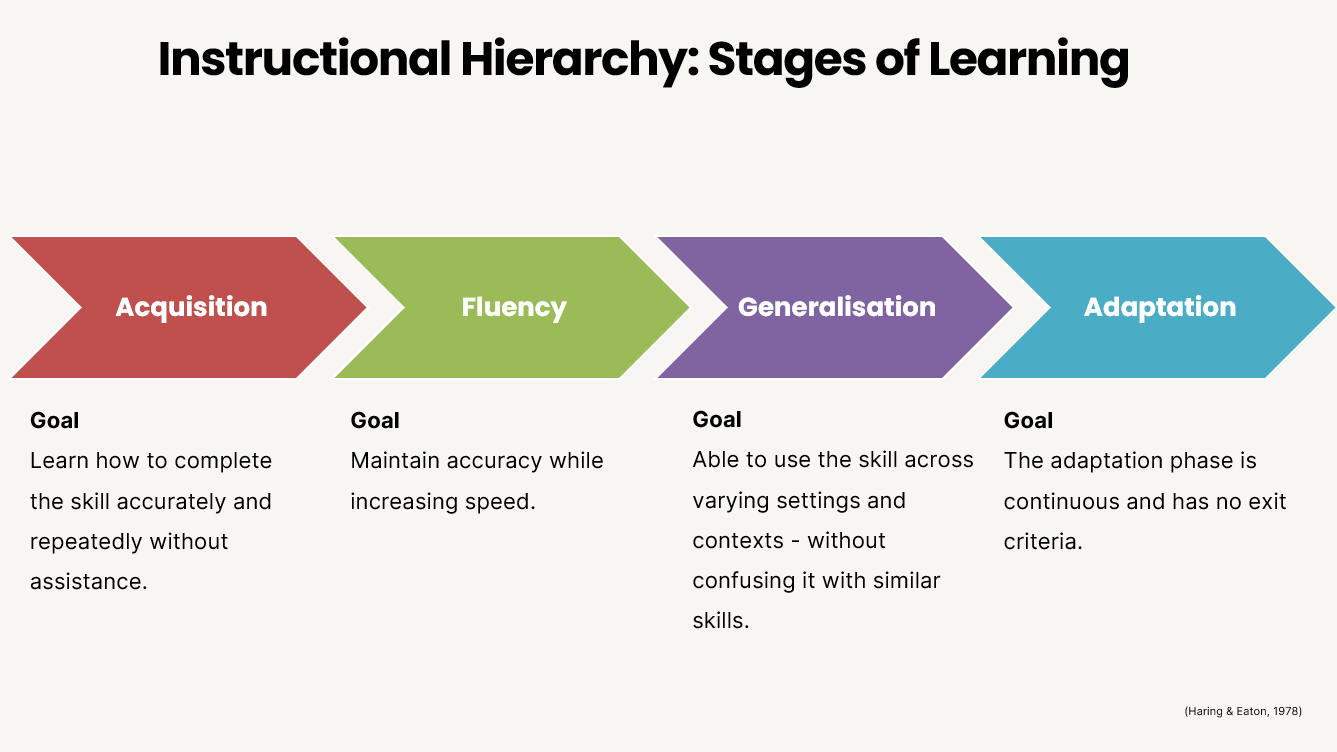
One way to think about this is through the Instructional Hierarchy (Haring & Eaton, 1978). Learners first acquire a skill, then build fluency, before they can reliably generalise and adapt it. What we often label as “discovery” sits at the top of this hierarchy. It only becomes available once the earlier stages have done their work. Contingency adduction explains how that upper part of the hierarchy works. Fluent skills are recruited and recombined when the task demands it.
Fluency reflects performance that is stable, automatic and available under pressure, not knowledge that only works when conditions are carefully controlled (Binder, 1996; Johnson & Layng, 1996). At Morningside Academy, this looks like 80-100 maths facts per minute and for passage fluency 180-220 words per minute (Johnson et al., 2021).
Automatic does not mean mindless. It means the skill runs without effort. It does not compete for attention. It does not slow thinking down.
When skills are not automatic, students are busy just trying to perform them. They pause to recall facts, check steps, or decode the task itself. Working memory is consumed by execution, leaving very little space for reasoning.
When skills are automatic, something important changes. Students can think about what the task is asking rather than how to carry out each step. Their attention shifts from procedure to structure.
This is why fluency matters so much. Fluency is what turns a skill from something students can do into something they can use. It is the difference between knowing and thinking.
A simple way to tell whether a skill is automatic is to ask this:
Can the student use it while thinking about something else?
If the answer is no, discovery will not help. The task will feel confusing rather than revealing.
Making skills automatic is not about rushing or drilling for speed. It is about removing friction. It is about ensuring the basics are reliable enough to disappear into the background.
3. Design for the “Aha!”, Not the “Huh?”
Discovery does not begin with the task. It begins long before students ever see it. By the time a student reaches an “aha” moment, the teacher has already done the heavy lifting. Fluency has been built deliberately. What looks like insight at the end of the sequence is the result of careful preparation at the start (Layng et al., 2004).
When this work has not been done, discovery feels very different. Students hesitate. They guess. They focus on surface features. The task produces confusion rather than clarity. That is the “huh”.
Designing for the “aha” means being ruthless about prerequisites. It means asking in advance what students will need to already know and be able to do automatically before a task can work as intended (Tiemann & Markle, 1990). If a task requires blending, calculating, interpreting, or comparing, those actions cannot still be fragile. They must already run smoothly in the background.
This is where tool and component skills matter. Tool skills need to be reliable enough that students do not notice themselves using them. Component skills need to be familiar enough that students recognise when they are relevant. Only then can a new task quietly pull those skills together.
When teachers skip this preparation and move straight to the task, they often misread what they see. Struggle is mistaken for thinking. Errors are treated as productive. In reality, the task is asking students to do too many things at once.
Designing for the “aha” is not about making tasks easier. It is about making thinking possible. The task should demand connection, not recall. It should require recombination, not improvisation.

When the design is right, the task does the recruiting. This is when we see “curriculum leaps” (Johnson & Layng, 1992). Students are not told what to do. They simply see what needs to be done. The moment feels like discovery, because it is. It just happens to be one the teacher planned for.
The Five Signatures of Insight
Instructional designers have identified at least five distinct ways you can engineer this recruitment. If you want to build a discovery lesson, you are likely looking to trigger one of these specific variations (Johnson et al, 2021):
Adduction of a New Sequence: You teach Skill A and Skill B separately. You then present a problem that requires doing A then B. The student “discovers” the chain. This is the backbone of complex maths.
Adduction of a New Blend: You teach two distinct actions (like a student saying /c/ and /l/). When presented with a combined signal, the learner “blends” them into a novel composite (/cl/) (Layng, Twyman and Stikeleather, 2004).
Adduction by Context: The learner knows a complex skill. You present a new context that requires only part of that skill. The learner “discovers” how to break their own behaviour down to fit the new constraint.
Adduction by Elimination: You teach a student to select a specific shape. You then present a screen with that shape and a new, unknown shape, but ask them to select the new one. Through the process of elimination (rejecting the known), they “discover” the new category without being told what it is (Layng et al., 2003).
Adduction of Equivalence: You teach that A = B and B = C. You never teach A = C, yet the student “discovers” this relationship on their own. This is how deep conceptual networks are formed (Sidman, 1994; Shapiro, 2024).
When these signatures appear, it is a sign the design is working. When they do not, it is a sign to revisit the preparation, not the task.
What Happens When the Conditions Are Right
Consider early reading instruction. In a landmark study by Layng, Twyman and Stikeleather (2004), learners were taught individual letter-sound correspondences to fluency. They were then presented with unfamiliar letter combinations and asked to respond. Crucially, the blended sounds had never been taught.

The result? Between 80 and 95 percent of learners correctly identified the new sound combinations on their very first attempt. The blending behaviour appeared immediately. This was not inference or trial and error. It was the recombination of fluent component skills under new stimulus conditions. The discovery was real and it was engineered.
We see the same “curriculum leap” in mathematics. At Morningside Academy, students struggled with complex fraction word problems. Rather than teaching the problems directly, educators focused on the components:
Fraction computation (the maths)
Whole number word problem schemas (the logic)
Once these two skills were built to high fluency, students were tested on fraction word problems they had never seen. Performance improved dramatically (Johnson & Layng, 1992). The students automatically recruited their calculation fluency and applied it to the word problems. This focus on fluency allowed students to make ‘curriculum leaps,’ averaging over two years of academic growth for every year of instruction (Johnson & Street, 2012).
The “aha” occurred only because the underlying skills were so well established that they could be recruited and combined. This is the opposite of discovery as trial and error. It is discovery as recombination.
Why this matters
These findings are important because they show that discovery is not a mysterious cognitive leap. It is a predictable outcome when instruction has done its work. When component skills are fluent, the learner finally has the cognitive space to think.
Designing for Discovery in the Classroom
Planning for contingency adduction looks different from traditional lesson planning. It starts with the outcome you want learners to reach and works backwards to make that outcome likely.
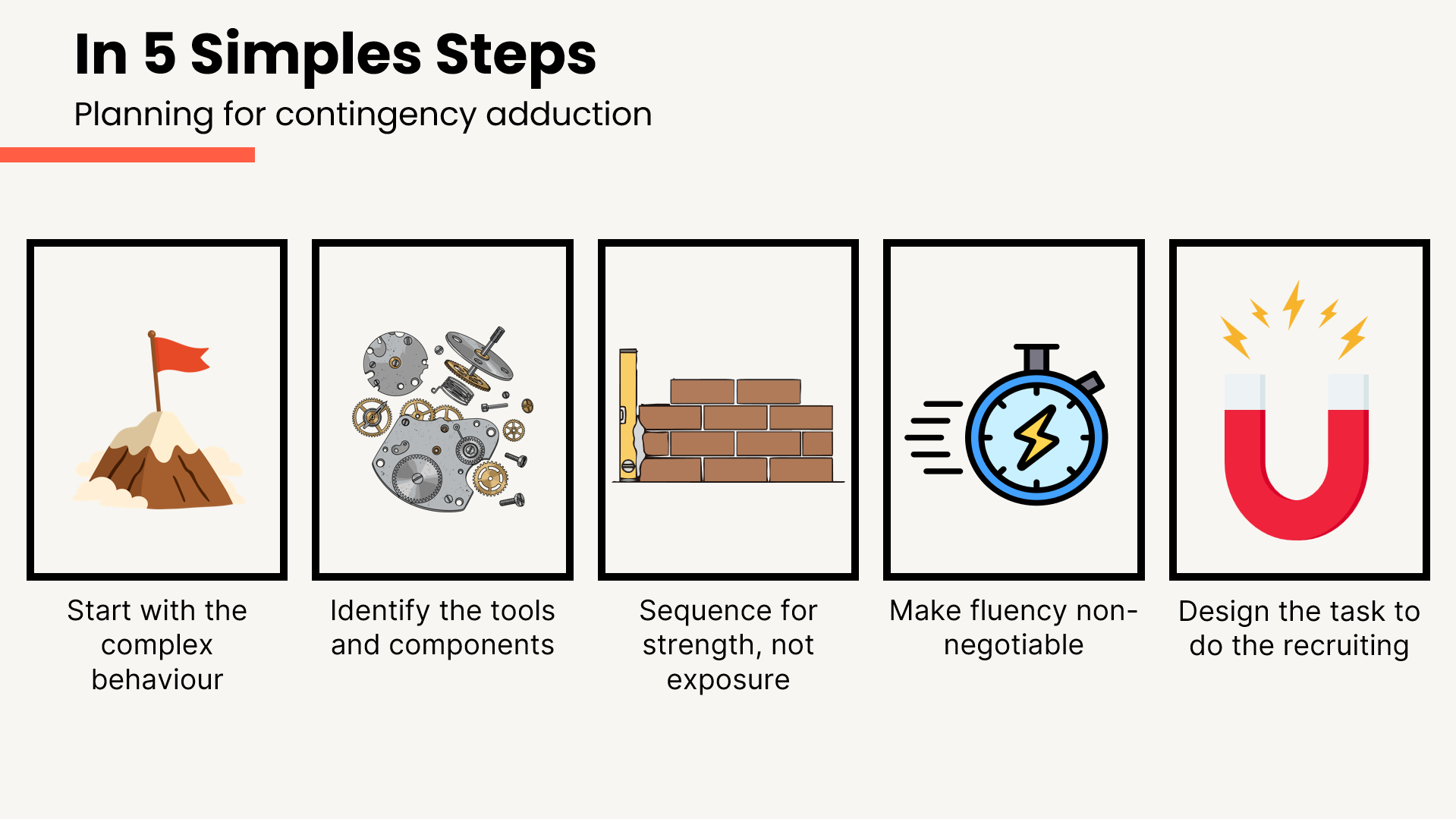
1. Start with the complex behaviour
Be clear about the kind of thinking or problem solving you want learners to demonstrate independently. This is the behaviour that should eventually feel like discovery to the learner.
2. Identify the tools and components
Break the complex behaviour into tool skills and component skills.
Tool skills are the smallest building blocks. Component skills are combinations of those tools that still need to be taught explicitly. These are the skills that will later be recruited when learners face something new.
If the tools or components are missing, discovery cannot happen.
3. Sequence for strength, not exposure
Ensure that each prerequisite is firmly in place before it is required.
This is not about covering content. It is about building a broad enough repertoire that skills are available when a task demands them. The stronger the foundation, the more likely recombination becomes.
4. Make fluency non-negotiable
Skills need to work without effort if they are going to be used in thinking. Prioritise repeated opportunities for high quality responding, so that core skills become automatic (Johnson & Layng, 1996).
If a skill still demands attention, it will block discovery rather than enable it.
5. Design the task to do the recruiting
Only once the prerequisites are fluent should you introduce a novel task.
Do not cue the solution. Do not break the task down again. Let the task quietly pull together what learners already know. When the design is right, success is reinforcing in its own right.
Discovery is not something you add at the end. It is what happens when the design has done its job. If you find yourself explaining the solution, the task was introduced too early.
In a nutshell
Contingency adduction provides a clear explanation for why discovery learning sometimes works and often fails. It works when learners have earned the right to discover through carefully sequenced instruction and sufficient fluency.
We do not need to choose between rigour and discovery. Explicit instruction is not the opposite of discovery. It is what makes discovery possible. When instruction is designed well, discovery is not a gamble. It is the outcome.
None of this is abstract theory. It has very real implications for how we design maths instruction day to day.
In my upcoming course, The Primary Maths Instruction Framework, we work through these ideas in detail using mathematics as the anchor: identifying prerequisite skills, building fluency intentionally and designing tasks that reliably produce insight rather than confusion.
If you’re interested in how all of this goes together, you can find the details here:
https://events.humanitix.com/the-primary-maths-instruction-framework
References
Andronis, P. T., Layng, T. J., & Goldiamond, I. (1997). Contingency adduction of “symbolic aggression” by pigeons. The Analysis of Verbal Behavior, 14(1), 5-17.
Binder, C. (1996). Behavioral fluency: Evolution of a new paradigm. The Behavior Analyst, 19(2), 163–197.
Haring, N. G. & Eaton, M. D. (1978). Systematic Instructional Procedures: An Instructional Hierarchy.
Johnson, K. R., & Layng, T.V.J. (1992). Breaking the structuralist barrier: Literacy and numeracy with fluency. American psychologist, 47(11), 1475.
Johnson, K. R., & Layng, T.V.J. (1996). On terms and procedures: Fluency. The Behavior Analyst, 19(2), 281-288.
Johnson, K. R., & Street, E. M. (2012a). From the laboratory to the field and back again Morningside Academy’s 32 years of improving students’ academic performance. The Behavior Analyst Today, 13(1), 20.
Johnson, K. R., & Street, E. M. (2013). Response to intervention and precision teaching: Creating synergy in the classroom. Guilford Press.
Johnson, K.R., Street, E.M., Kieta, A.R. & Robbins, J.K. (2021). The Morningside Model of Generative Instruction: Building a Bridge Between Skills and Inquiry Teaching. Cornwell-on-Hudson, NY: Sloan Publishing.
Kubina, R. M., Jr., & Morrison R. S. (2000). Fluency in Education. Behavior and Social Issues, 10, 83-99
Layng, T.V.J., Twyman, J. S., & Stikeleather, G. (2004). Engineering discovery learning: The contingency adduction of some precursors of textual responding in a beginning reading program. The Analysis of Verbal Behavior, 20(1), 99-109.
Leon, M., Layng, T.V.J., & Sota, M. (2011). Thinking through text comprehension III: The programing of verbal and investigative repertoires. The Behavior Analyst Today, 12(1), 22.
Spencer, T. D. (2021). Ten instructional design efforts to help behavior analysts take up the torch of direct instruction. Behavior Analysis in Practice, 14(3), 816-830
Tiemann, P.W. and Markle, S.M. (1990) Analyzing instructional content: A guide to instruction and evaluation. 4th edn. Champaign, IL: Stipes Publishing Company.
Twyman, J. S. (2021). The evidence is in the design. Perspectives on Behavior Science, 44(2), 195-223
Ooh, I love the mountain summiting metaphor! Your nuanced approach reminds me of Lauren Brown’s recent essay on which facts are worth memorizing in history class— another masterclass in rejecting “either-or” thinking and drilling down into the nuance of when a certain approach is appropriate.
Your article opened me up to the complexity of what I do when I 'enact' teaching. It made me think of Bruner's 'spiral curriculum' and Vygotsky's ZPD and how dynamic the learning process shifts in any lesson, let alone across a unit of work. Ironically, one of the best examples I thought of through your concept of designing for the 'ahha' and not 'huh' was when I worked as part of the 'structured literacy' program with Years 7 & 8 in my school. Yes, sequencing was so important, even drilling had its place when teaching kids to go from decoding to comprehension. Nonetheless, the prize is COMPREHENSION and not just achieving the combining of phonemes. Perhaps then, what you illustrate is that, professional speaking, we may not be as good as we think we are of understanding what development looks like in a specific domain... I know I feel this every time I'm required to teach out of my area of expertise. And let's face it, with teacher shortages, this is now an everyday recurrence. I know when I can't see the road ahead I feel stuck and I fall back on 'controlling' my uncertainty - that translates, of course, to controlling the kids to do 'the work'. However, when I can see the 'ahha', developmentally speaking, I literally feel free to move with all the different rates of developmental manifestations that my students present. I hope you continue to think and write about the meaning of 'ahha' and provoke us to think even more about it.